What Type of Art Was Very Well Done by Sumerians?
The Mesopotamian Cultures
Sumer was an ancient Chalcolithic civilization that saw its artistic styles modify throughout different periods in its history.
Learning Objectives
Talk over the historical importance of the diverse civilizations that existed in Mesopotamia
Key Takeaways
Fundamental Points
- The Eridu economic system produced arable food, which immune its inhabitants to settle in one location and form a labor force specializing in diverse arts and crafts.
- Writing produced during the early Sumerian period suggest the abundance of pottery and other artistic traditions.
- Elements of the early Sumerian culture spread through a large area of the Virtually and Middle East.
- The Sumerian urban center states rose to power during the prehistorical Ubaid and Uruk periods.
Primal Terms
- theocratic:A form of government in which a deity is officially recognized equally the civil ruler. Official policy is governed by officials regarded as divinely guided, or is pursuant to the doctrine of a detail religion or religious group.
- casting:A sculptural process in which molten material (usually metal) is poured into a mold, immune to cool and harden, and become a solid object.
- Cuneiform:I of the earliest known forms of written expression that began as a system of pictographs. It emerged in Sumer around the 30th century BC, with predecessors reaching into the late 4th millennium (the Uruk IV menses).
- Chalcolithic:Too known as the Copper Age, a phase of the Bronze Historic period in which the addition of can to copper to form statuary during smelting remained yet unknown. The Copper Age was originally defined equally a transition betwixt the Neolithic and the Bronze Age.
Sumer was an ancient culture in southern Mesopotamia (mod Iraq) during the Chalcolithic and Early Bronze Ages. Although the historical records in the region do not get back much further than ca. 2900 BCE, modernistic historians believe that Sumer was first settled between ca. 4500 and 4000 BCE by people who may or may not accept spoken the Sumerian language. These people, now chosen the "Ubaidians," were the first to drain the marshes for agriculture; develop merchandise; and establish industries including weaving, leatherwork, metalwork , masonry, and pottery.
The Sumerian urban center of Eridu, which at that time bordered the Persian Gulf, is believed to exist the world'due south get-go metropolis. Hither, three split cultures fused—the peasant Ubaidian farmers, the nomadic Semitic-speaking pastoralists (farmers who raise livestock), and fisher folk. The surplus of storable food created by this economy allowed the region's population to settle in one identify, instead of migrating as hunter-gatherers. Information technology also allowed for a much greater population density, which required an extensive labor forcefulness and a segmentation of labor with many specialized arts and crafts.
An early form of wedge-shaped writing called cuneiform adult in the early Sumerian period. During this time, cuneiform and pictograms suggest the affluence of pottery and other creative traditions. In addition to the product of vessels , clay was too used to make tablets for inscribing written documents. Metallic also served various purposes during the early Sumerian period. Smiths used a grade of casting to create the blades for daggers. On the other hand, softer metals like copper and aureate could exist hammered into the forms of plates, necklaces, and collars.

Stele of the Vultures: Battle formations on a fragment of the Stele of the Vultures. Case of Sumerian pictorial cuneiform writing.
By the late fourth millennium BCE, Sumer was divided into nigh a dozen independent city-states delineated by canals and other boundary makers. At each city heart stood a temple dedicated to the particular patron god or goddess of the city. Priestly governors ruled over these temples and were intimately tied to the city's religious rites.

Sumer: Map of the Cities of Sumer.
The Ubaid Period
The Ubaid menstruation is marked by a distinctive style of painted pottery, equally seen in the example below, produced domestically on a slow wheel. This style eventually spread throughout the region. During this time, the offset settlement in southern Mesopotamia was established at Eridu by farmers who first pioneered irrigation agriculture. Eridu remained an important religious center even subsequently nearby Ur surpassed information technology in size.

Ubaid pottery
The Uruk Period
The transition from the Ubaid period to the Uruk period is marked by a gradual shift to a great variety of unpainted pottery mass-produced by specialists on fast wheels. The trough beneath is an case of pottery from this catamenia.

Uruk trough: The unpainted surface of this trough marks it every bit a production of the Uruk period.
By the time of the Uruk period (ca. 4100–2900 BCE), the volume of trade goods transported forth the canals and rivers of southern Mesopotamia facilitated the ascent of many large, stratified , temple-centered cities where centralized administrations employed specialized workers. Artifacts of the Uruk culture take been constitute over a wide area—from the Taurus Mountains in Turkey, to the Mediterranean Sea in the west, and equally far due east as Central Islamic republic of iran. The Uruk culture, exported by Sumerian traders and colonists, had an effect on all surrounding peoples, who gradually developed their own comparable, competing economies and cultures.
Sumerian cities during the Uruk menstruation were probably theocratic and likely headed past priest-kings (ensis), assisted past a council of elders, including both men and women. The subsequently Sumerian pantheon (gods and goddesses) was likely modeled upon this political structure. There is little evidence of institutionalized violence or professional soldiers during the Uruk menstruation. Towns generally lacked fortified walls, suggesting little, if any, need for defense. During this period, Uruk became the well-nigh urbanized city in the world, surpassing for the first time fifty,000 inhabitants.
Gilgamesh
The earliest king authenticated through archaeological evidence is Enmebaragesi of Kish, whose proper noun is likewise mentioned in the Gilgamesh epic (ca. 2100 BCE)—leading to the proffer that Gilgamesh himself might have been a historical king of Uruk. Every bit the Epic of Gilgamesh shows, the second millennium BCE was associated with increased violence. Cities became walled and increased in size as undefended villages in southern Mesopotamia disappeared.
Ceramics in Mesopotamia
The invention of the potter's wheel in the fourth millennium BCE led to several stylistic shifts and varieties in form of Mesopotamian ceramics.
Learning Objectives
Differentiate Ubaid pottery from later styles in Mesopotamian ceramics
Primal Takeaways
Cardinal Points
- The invention and development of the potter's wheel immune individuals to produce vessels at increasing speeds and in increasing numbers.
- Ubaid pottery was more than decorative and unique than Uruk pottery.
- As ceramics evolved, shapes and sizes of dirt objects became more varied.
- Clay could besides be used for writing tablets that could be fired, if the owner believed the text was important.
Key Terms
- ceramics:The craft of making objects from dirt.
- throwing:Shaping clay on a potter'due south wheel.
- stylus:A writing implement that incises lines into surfaces, such equally clay.
- kiln:A special kind of oven used for firing ceramic objects at high temperatures.
Although ceramics developed in East Asia c. twenty,000-x,000 BCE, the exercise of throwing arose with the invention of the potter's wheel in Mesopotamia around the fourth millennium BCE. The earliest clay vessels date to the Chalcolithic Era, which is divided into the Ubaid (5000-4000 BCE) and Uruk (4000-3100 BCE) periods.
The Chalcolithic Era
The Ubaid period is marked by a distinctive mode of fine quality painted pottery which spread throughout Mesopotamia. Ceramists produced vases, bowls, and small jars domestically on slow wheels, painting unique abstruse designs on the fired clay.

Vase from the Late Ubaid Catamenia, 4500-4000 BCE: A pottery jar from the Late Ubaid Catamenia on display in the Museum of Fine Arts, Boston.
Experts differentiate the Ubaid period from the Uruk menstruum by the style of pottery produced in each era. During the Uruk flow, the potter'south wheel advanced to let for faster speeds. As such, ceramists could produce pottery more than quickly, leading to the mass production of standardized, unpainted styles of vessels.
The Akkiadian Empire
As the Akkadian Empire overtook the Sumerian city-states , ceramists continued to produce bowls, vases, jars, and other objects in a diverseness of shapes and sizes. Like Uruk pottery, the surfaces of these objects were left unpainted, although some vessels appear to take a form of abstract reliefs on the surface. This photo displays the various forms (including a class that resembles a present-day cake stand) that pottery took during the Akkadian Empire.

Akkadian pottery: A collection of Akkadian pottery on brandish at the Oriental Institute Museum, Academy of Chicago.
Ur Three
The Third Ur Dynasty , better known equally Ur III, witnessed the continuation of unpainted ceramic vessels that took a variety of forms. This photograph depicts an urn that resembles today's flower vases, as well as bowls, cups, and a smaller vase.

Pottery from the Ur III period: A collection of pottery from the Ur Iii flow on display at the Oriental Constitute Museum, University of Chicago.
Equally in previous eras, clay was also used to produce writing tablets that were incised with styluses fashioned from blunted reeds. Often, tablets were used for record-keeping (the ancient version of an office memo). Like other ceramic objects, tablets could be fired in a kiln to produce a permanent form if the text was believed significant enough to preserve. The tablets in the photograph below contain data about farm animals and workers.

Authoritative texts in cuneiform writing: A collection of administrative texts in cuneiform writing on display at the Oriental Establish Museum, University of Chicago.
Babylonian Ceramics
Pottery produced during the "Onetime" Babylonian catamenia shows a return to painted abstract designs and increased variety in forms. In this photograph, a bowl, a jar, and a goblet prove remnants of paint on their exteriors.

Old Babylonian pottery: A collection of erstwhile Babylonian pottery on display at the Oriental Establish Museum, University of Chicago.
Sculpture in Mesopotamia
While the purposes that Mesopotamian sculpture served remained relatively unchanged for 2000 years, the methods of conveying those purposes varied profoundly over time.
Learning Objectives
Identify the purposes of the sculptures featured in this concept
Primal Takeaways
Fundamental Points
- Mesopotamian sculptures were predominantly created for religious and political purposes.
- Mutual materials included clay, metal, and stone fashioned into reliefs and sculptures in the round .
- The Uruk menstruation marked a development of rich narrative imagery and increasing lifelikeness of man figures.
- Hieratic calibration was ofttimes used in Mesopotamian sculpture to convey the significance of gods and royalty.
- After the terminate of the Uruk period, bailiwick affair began to describe scenes of warfare and became increasingly trigger-happy and intimidating.
Key Terms
- register:A usually horizontal partitioning of split scenes in ii- or 3-dimensional art.
- hieratic scale:A visual method of marker the significance of a effigy through its size. The more of import a effigy is, the larger it appears.
- terra cotta:Clay that has been fired in a kiln.
- high relief:A sculpture that projects significantly from its background, providing deep shadows.
- votive:An object left in temples or other religious locations for a variety of spiritual purposes.
- jumbo:Extremely tall.
- lyre:A hand-held stringed instrument resembling a pocket-size harp.
- cylinder seal:A small object adorned with carved images of animals, writing, or both, used to sign official documents.
- in the round:Sculpture that stands freely, divide from a background.
- relief:A sculpture that projects from a background.
- mixed-media:Artwork consisting of ii or more unlike materials.
- nomadic:Mobile; moving from one identify to another, never settling in 1 location for too long.
The current archaeological record dates sculpture in Mesopotamia the tenth millennium BCE, before the dawn of civilization . Sculptural forms include humans, animals, and cylinder seals with cuneiform writing and imagery in the round or as reliefs. Materials range from terra cotta , stones like alabaster and gypsum, and metals like copper and bronze .
Hunter-Gatherers and Samarra
Because the artists of the hunter-gatherer era were nomadic , the sculptures they produced were small and lightweight. Even after cultures discovered agricultural methods, such as irrigation and animate being domestication, artists continued to produce minor sculptures. The seated female effigy below (c. 6000 BCE), probable carved from a single stone, hails from the prehistoric Samarra civilization (5500-4800 BCE). Similar many prehistoric female figures, the features of this sculpture suggest that it was used in fertility rituals . Its breasts are accentuated, and its legs are spread in a position that might resemble a woman in labor. While the artist emphasized areas of the body related to reproduction, he or she did non add facial features or feet to the figure.

Female person statuette from Samarra (c. 6000 BCE): A female person statuette from Samarra on display at the Louvre Museum.
Uruk Period
Spirituality and communication are reflected in sculptures dating the Uruk period (4000-3100 BCE) of the late prehistoric era. Scholars believe that the gypsum Uruk trough was used as part of an offering to Inanna, the goddess of fertility, love, war, and wisdom. In addition to reliefs of animals, reliefs of reed bundles, sacred objects associated with Inanna, adorn the outside of the trough. For these reasons, scholars do non believe the trough was used for agronomical purposes.

Uruk trough (3300-3000 BCE): An Uruk trough on brandish at the British Museum.
Animals, along with forms of writing, besides appear on early cylinder seals, which were carved from stones and used to notarize documents. Officials or their scribes rolled the seals on wet clay tablets as a class of signature. Cylinder seals were also worn as jewelry and have been found forth with precious metals and stones in the tombs of the aristocracy members of society. The trough, cylinder seals, and diverse other sculptures of the Uruk menstruation serve as examples of the rich narrative imagery that arose during this fourth dimension.

Uruk-flow cylinder seal with stamped clay tablet (4100-3000 BCE): An Uruk-flow cylinder seal and stamped dirt tablet featuring monstrous lions and king of beasts-headed eagles, on display at the Louvre Museum.
The Uruk period also marked an evolution in the depiction of the man trunk, every bit seen in the Mask of Warka (c. 3000 BCE), named for the present-twenty-four hour period Iraqi metropolis in which it was discovered. This marble "mask" is all that remains of a mixed- media sculpture that also consisted of a wooden body, gold foliage "hair," inlaid "optics" and "eyebrows," and jewelry. Like most sculptures produced during the time, the sculpture was originally painted in an attempt to make information technology look lifelike.

Uruk Caput, also known as the Mask of Warka (c. 3000 BCE): The optics and eyebrows on this Uruk marble head are hollow to accommodate the original inlay.
Early Dynastic Period
Sculpture congenital on older traditions and grew more complex during the Early Dynastic Period (2900-2350 BCE). Although artists however used clay and stone, copper became the dominant medium. Subject matter focused on spiritual matters, state of war, and social scenes.
A cylinder seal discovered in the regal tomb of Queen Puabi depicts two registers of a palace banquet scene punctuated past cuneiform script, mark a growing complexity in the imagery of this form of notarization. Each register features hieratic scale, in which the queen (upper register) and the king (lower register) are larger than their subjects.
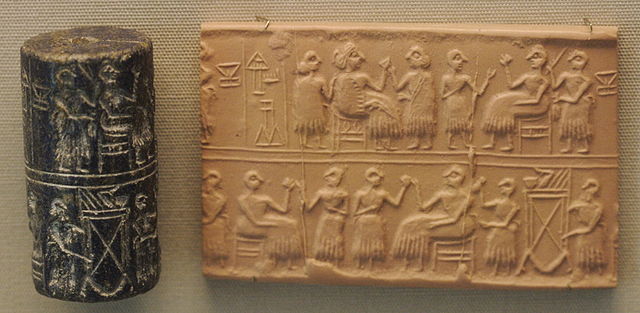
Cylinder seal and stamped dirt fragment from the tomb of Queen Puabi (c. 2600 BCE): The queen sits on the tiptop annals, while the king sits on the lesser. Each figure is set apart from his or her subjects through hieratic scale.
Another sculpture of note is a mixed-media bull'due south head that once adorned a ceremonial lyre found in Puabi's tomb in Ur. The caput consists of a gold "face up," lapis lazuli (a blue precious rock) "fur," and shell "horns." Although much of the lyre, whose dominant material was forest, disintegrated over fourth dimension, contemporaneous imagery depicts lyres with like decoration. Scholars believe that lyres were used in burying ceremonies and that the music that was played held religious significance.

Balderdash's head from ceremonial lyre (c. 2600 BCE): This lyre was establish in the tomb of queen Pu-Abi. The lapis lazuli, vanquish, cerise limestone decoration, and the head of the bull are original. The bull's caput is covered with golden. The optics are lapis lazuli and trounce. The beard and hair are lapis lazuli. A lyre of the same type is shown on the Standard of Ur.
Sculptures in human being form were besides used as votive offerings in temples. Among the all-time known are the Tell Asmar Hoard, a grouping of 12 sculptures in the circular depicting worshipers, priests, and gods. Like the cylinder seal establish in Queen Puabi's tomb, the figures in the Tell Asmar Hoard bear witness hieratic scale. Worshipers, equally in the image below, stand up with their arms in forepart of their chests and their hands in the position of property offerings. Materials range from alabaster to limestone to gypsum, depending on each effigy's significance. One common feature is the big hollowed out heart sockets, which were one time inlaid with rock to make them appear lifelike. The optics held spiritual significance, especially that of the gods, which represented awesome otherworldly power.

Votive figure of a male worshiper from Tell Asmar (2750-2600 BCE): The votive figure—made from alabaster, trounce, black limestone, and bitumen—depicts a male worshiper of Enil, a powerful Mesopotamian god.
Akkadian Empire
During the period of the Akkadian Empire (2271-2154 BCE), sculpture of the human form grew increasingly naturalistic, and its discipline matter increasingly about politics and warfare.
A cast bronze portrait head believed to exist that of King Sargon combines a naturalistic olfactory organ and mouth with stylized eyes, eyebrows, hair, and beard. Although the stylized features boss the sculpture, the level of naturalism was unprecedented.

Caput of an Akkadian ruler, probably Sargon (2270-2215 BCE): This portrait combines naturalistic and stylized facial features and was cast using the lost-wax method. The eye sockets were once inlaid.
The Victory Stele of Naram Sin provides an example of the increasingly violent field of study affair in Akkadian art, a result of the trigger-happy and oppressive climate of the empire. Here, the king is depicted as a divine effigy, every bit signified by his horned helmet. In typical hieratic manner, Naram Sin appears larger than his soldiers and his enemies. The king stands among dead or dying enemy soldiers as his own troops look on from a lower vantage point. The figures are depicted in high relief to dilate the dramatic significance of the scene. On the right hand side of the stele, cuneiform script provides narration.

Victory Stele of Naram-Sin (12th century BCE): The king stands in the middle of the stele wearing a horned headpiece. His dead and dying enemies environs him while his ain soldiers passively notice.
Babylon and Assyria
The second millennium BCE marks the transition from the Middle Bronze Historic period to the Late Bronze Historic period . The virtually prominent cultures in the aboriginal Near East during this period were Babylonia and Assyria. Clay was the dominant medium during this fourth dimension, just stone was likewise used. The nearly common surviving forms of second millennium BCE Mesopotamian fine art are cylinder seals, relatively small free-standing figures, and reliefs of diverse sizes. These included inexpensive plaques, both religious and otherwise, of molded pottery for private homes.
Babylonian culture somewhat preferred sculpture in the round to reliefs. Depictions of human figures were naturalistic. The Assyrians, on the other paw, adult a style of large and exquisitely detailed narrative reliefs in painted rock or alabaster. Intended for palaces, these reliefs draw imperial activities such as battles or hunting. Predominance is given to brute forms, particularly horses and lions, which are represented in great detail. Human figures are static and rigid by comparing, just as well minutely detailed. The Assyrians produced very petty sculpture in the round with the exception of colossal guardian figures, usually lions and winged beasts, that flanked fortified imperial gateways. While Assyrian artists were greatly influenced by the Babylonian way, a distinctly Assyrian creative style began to sally in Mesopotamia around 1500 BCE.

Burney Relief (c. 1800-1750 BCE): The Burney Relief is a Mesopotamian terra cotta plaque in high relief of the Old-Babylonian period, depicting a winged, nude, goddess-like effigy with bird'southward talons, flanked by owls, and perched upon supine lions. Autonomously from its distinctive iconography, the sculpture is noted for its loftier relief and relatively large size, which suggests that is was used as a cult relief, which makes it a very rare survival from the menses.
Compages in Mesopotamia
Domestic and public architecture in Mesopotamian cultures differed in relative simplicity and complexity. Equally time passed, public architecture grew to monumental heights.
Learning Objectives
Differentiate how Mesopotamian cultures approached domestic and public compages
Key Takeaways
Cardinal Points
- Mesopotamian cultures used a multifariousness of building materials. While mud brick is the most mutual, stone also features as a structural and decorate element.
- The ziggurat marked a major architectural achievement for the Sumerians , as well as subsequent Mesopotamian cultures.
- Palaces and other public structures were frequently decorated with glaze or pigment, stones, or reliefs .
- Animals and human-creature hybrids feature in the religions of Mesopotamian cultures and were often used as architectural decoration.
Key Terms
- alto relief:A sculpture with significant project from its background.
- bas reliefs:Sculptures that minimally project from their backgrounds.
- public sphere:The world outside the abode.
- ziggurat:A towering temple, similar to a stepped pyramid, that sat in the eye of Mesopotamian metropolis-states in award to the local pantheon.
- private sphere:The home, or the domestic realm.
- load-begetting:A form of architecture in which the walls are the construction's main source of support.
- stacking and piling:A form of load-bearing architecture in which the walls are thickest at the base and grow gradually thinner toward the acme.
- pilaster:
A rectangular column that projects partially from the wall to which it is fastened; it gives the appearance of a support, but is just for decoration.
The Mesopotamians regarded "the craft of building" every bit a divine gift taught to men past the gods, and architecture flourished in the region. A paucity of stone in the region made sun baked bricks and clay the edifice material of choice. Babylonian compages featured pilasters and columns , too as frescoes and enameled tiles. Assyrian architects were strongly influenced past the Babylonian style , but used rock as well as brick in their palaces, which were lined with sculptured and colored slabs of stone instead of being painted. Existing ruins point to load-bearing architecture equally the dominant form of edifice. However, the invention of the round arch in the general area of Mesopotamia influenced the construction of structures like the Ishtar Gate in the 6th century BCE.
Domestic Architecture
Mesopotamian families were responsible for the construction of their own houses. While mud bricks and wooden doors comprised the dominant building materials, reeds were too used in construction. Considering houses were load-bearing, doorways were often the only openings. Sumerian culture observed a rigid partition between the public sphere and the private sphere , a norm that resulted in a lack of directly view from the street into the dwelling. The sizes of individual houses varied, but the general design consisted of smaller rooms organized effectually a large central room. To provide a natural cooling effect, courtyards became a common feature in the Ubaid menses and persist into the domestic architecture of present-day Republic of iraq.
Ziggurats
One of the most remarkable achievements of Mesopotamian architecture was the development of the ziggurat, a massive structure taking the form of a terraced pace pyramid of successively receding stories or levels, with a shrine or temple at the summit. Like pyramids, ziggurats were congenital by stacking and piling . Ziggurats were not places of worship for the general public. Rather, merely priests or other authorized religious officials were allowed inside to tend to cult statues and make offerings . The first surviving ziggurats appointment to the Sumerian civilisation in the fourth millennium BCE, but they continued to be a popular architectural class in the late third and early 2nd millennium BCE as well .

Chogha Zanbil ziggurat: The Chogha Zanbil ziggurat was congenital in 1250 BC past Untash-Napirisha, the king of Elam, to honour the Elamite god Inshushinak.
The paradigm below is an creative person's reconstruction of how ziggurats might take looked in their heyday. Human figures appear to illustrate the massive calibration of these structures. This impressive summit and width would not have been possible without the apply of ramps and pulleys.
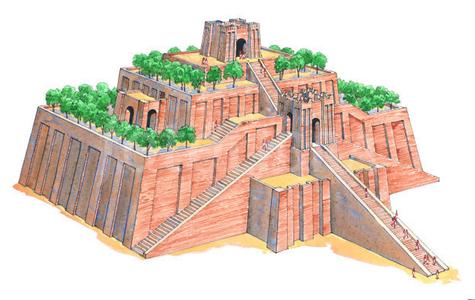
An artist'south reconstruction of a ziggurat: Like virtually Mesopotamian architecture, ziggurats were equanimous of sun-baked bricks, which were less durable than their oven-baked counterparts. Thus, buildings had to be reconstructed on a regular basis, ofttimes on the foundations of recently deteriorated structures, which caused cities to become increasingly elevated. Lord's day-baked bricks remained the dominant building fabric through the Babylonian and early Assyrian empires.
Political Architecture
The exteriors of public structures like temples and palaces featured decorative elements such as bright paint, gold, foliage, and enameling. Some elements, such as colored stones and terracotta panels, served a twofold purpose of decoration and structural support, which strengthened the buildings and delayed their deterioration.
Betwixt the thirteenth and tenth centuries BCE, the Assyrians replaced lord's day-baked bricks with more durable stone and masonry. Colored stone and bas reliefs replaced pigment as ornament. Fine art produced nether the reigns of Ashurnasirpal II (883-859 BCE), Sargon Ii (722-705 BCE), and Ashurbanipal (668-627 BCE) inform us that reliefs evolved from simple and vibrant to naturalistic and restrained over this time span.
From the Early on Dynastic Period (2900-2350 BCE) to the Assyrian Empire (25th century-612 BCE), palaces grew in size and complexity. However, even early palaces were very large and ornately decorated to distinguish themselves from domestic architecture. Because palaces housed the royal family and everyone who attended to them, palaces were oft bundled like small cities, with temples and sanctuaries , as well as locations to inter the dead. As with private homes, courtyards were important features of palaces for both utilitarian and ceremonial purposes.
By the time of the Assyrian empire, palaces were decorated with narrative reliefs on the walls and outfitted with their own gates. The gates of the Palace of Dur-Sharrukin, occupied by Sargon Ii, featured monumental alto reliefs of a mythological guardian figure called a lamassu (also known as a shedu), which had the head of a human, the body of a balderdash or lion, and enormous wings. Lamassu figure in the visual art and literature from virtually of the ancient Mesopotamian world, going as far back as ancient Sumer (settled c. 5500 BCE) and standing guard at the palace of Persepolis (550-330 BCE).

Lamassu: This is just 1 instance of how a lamassu would appear in Mesopotamian art. Other sculptures wear conical caps, face the front, or have the bodies of lions. In literature, some lamassu causeless female form.
Although the Romans oft receive credit for the circular arch, this structural system actually originated during aboriginal Mesopotamian times. Where typical load-begetting walls are non stiff enough to have many windows or doorways, round arches absorb more pressure level, allowing for larger openings and improved airflow. The reconstruction of Dur-Sharrukin shows that the round arch was existence used every bit entryways by the eighth century BCE.

Palace of Dur-Sharrukin: Circular arches can exist establish in the central portal, as well as in each window on the right and left.
Perhaps the best known surviving example of a round arch is in the Ishtar Gate, which was part of the Processional Style in the city of Babylon. The gate, now in the Pergamon Museum in Berlin, was lavishly decorated with lapis lazuli complemented past blueish glazed brick. Elsewhere on the gate and its connecting walls were painted floral motifs and bas reliefs of animals that were sacred to Ishtar, the goddess of fertility and war.

Ishtar Gate (c. 575 BCE): The reconstruction of the Ishtar Gate in the Pergamon Museum in Berlin.
The photograph above shows the immense scale of the gate. The photograph beneath shows the item of a relief of a bull from the gate's wall.

Detail of balderdash relief on Ishtar Gate: An aurochs, or bull, above a flower ribbon.
Source: https://courses.lumenlearning.com/boundless-arthistory/chapter/mesopotamia/
0 Response to "What Type of Art Was Very Well Done by Sumerians?"
Post a Comment